Home › Antique Holy Land Maps › The Holy Land
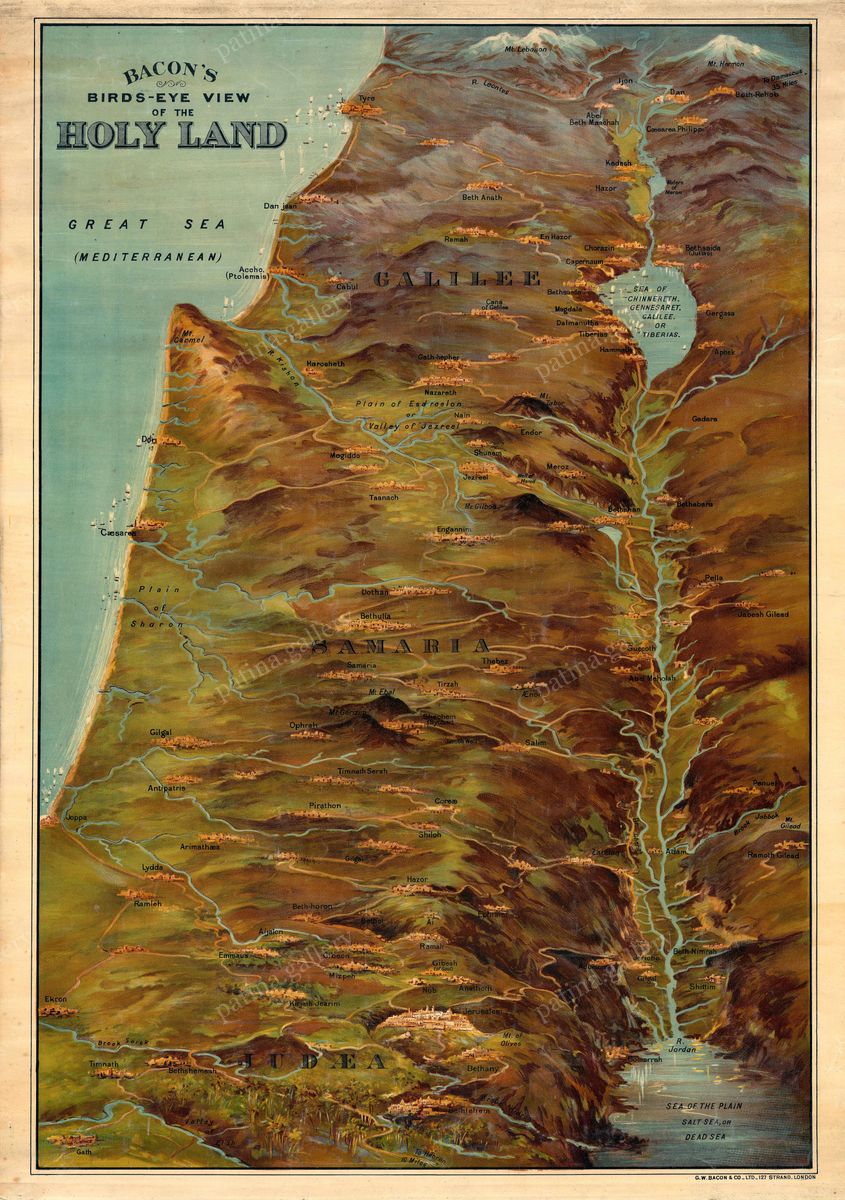
The Holy Land — Antique Map (1890)
George Washington Bacon, 1890 — Holy Land
This is not a flat map but Bacon's Bird's-Eye View of the Holy Land — a dramatic relief panorama that tilts the country into three dimensions, as if seen from high above the Mediterranean looking east. The Great Sea fills the left, the hill country of Galilee, Samaria and Judaea rises in modelled relief across the centre, and the Jordan threads down to the Sea of Galilee and the Dead Sea on the right. Towns, rivers and biblical sites are named throughout.
George Washington Bacon
George Washington Bacon (1830–1922) was a prolific London map publisher who supplied atlases and wall maps to a broad Victorian public. This pictorial bird's-eye view belongs to a popular genre of the period that turned geography into something vivid and immediate — closer to a painting than a survey, designed to let the viewer imagine walking the land of the Bible.
The land of Scripture in relief
By rendering Palestine as a modelled landscape rather than a plan, the view makes the terrain itself legible: the coastal plain, the central highlands, and the deep rift of the Jordan valley dropping to the Dead Sea, the lowest point on the Earth's surface. For a nineteenth-century audience steeped in Scripture, it offered an almost aerial pilgrimage over the Holy Land.
Collecting and display
Restored in high resolution from a public-domain original, its warm, painterly relief makes a striking and unusual wall piece. It is offered as an archival giclée print, framed and ready to hang, for anyone drawn to the Holy Land through history or faith.
Browse all Antique Holy Land Maps →
Catalogue & provenance
- Title
- Bacon's New Bird's-Eye View of the Holy Land
- Source
- Separately issued school map (London)
- Edition / state
- c.1890; a late-Victorian chromolithographic relief panorama, typically linen-backed on wooden rollers for classroom use.
- Catalogue reference
- British Library Maps catalogue
- Held by
- Private geographic and school-map collections.
Public-domain original; this is a restored, watermarked reproduction. We never distribute the high-resolution master. Catalogue data compiled from the institutions above.