Home › Antique World & Regional Maps › America
America — Antique Map (1572)
Abraham Ortelius, 1572 — The Americas
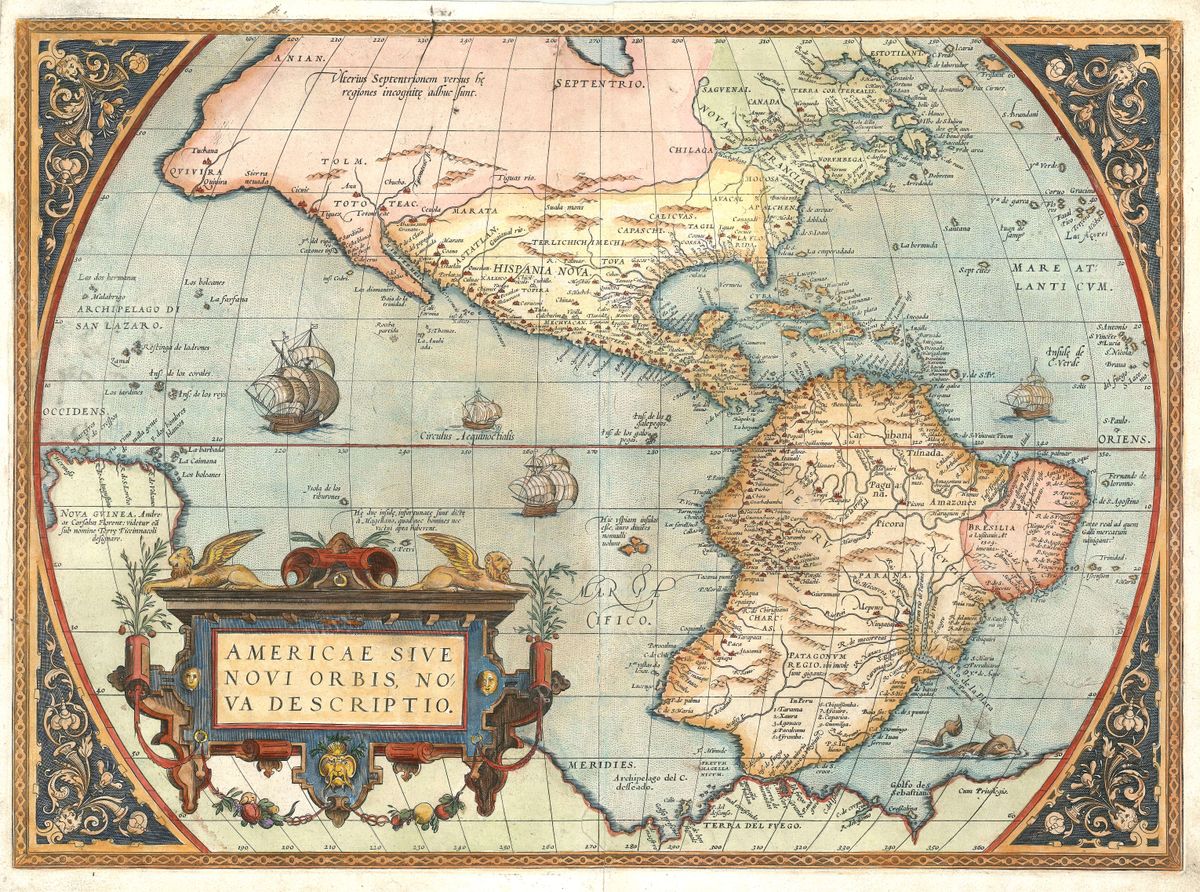
Abraham Ortelius (1527–1598) created the first modern atlas, the Theatrum Orbis Terrarum (1570), and his map of the Americas — engraved by Frans Hogenberg — is among the most celebrated maps ever made. This is the early plate (second state, of the 1570s), identifiable by the large ship sailing west in the Pacific and the ungraduated equator.
An error that dates the map
The south-west coast of South America bulges outward — a distortion Ortelius corrected in his 1587 plate — so this bulging version belongs to the 1570s. California, by contrast, is mapped correctly as a peninsula; seventeenth-century mapmakers would later regress and turn it into an island.
Imagined geography — and a flash of genius
A vast Terra Australis sweeps below the Strait of Magellan toward New Guinea, and a fictional river nearly links the St Lawrence to the Pacific. Yet Ortelius also studied how the continents' coastlines seemed to fit together and suggested they had once been joined — an early intimation of continental drift, three centuries before Wegener.
Collecting and display
Restored in high resolution from a public-domain original; a museum-grade archival giclée print, framed and ready to hang.
Browse all Antique World & Regional Maps →
Catalogue & provenance
- Title
- Americae Sive Novi Orbis Nova Descriptio
- Source
- Theatrum Orbis Terrarum
- Edition / state
- Engraved by Frans Hogenberg. First plate, second state (issued 1570–1575); identifiable by the large ship sailing west in the Pacific and the ungraduated equator. The Chilean bulge was corrected on the third plate of 1587.
- Catalogue reference
- van den Broecke, Ortelius Atlas Maps
- Held by
- Barry Lawrence Ruderman Antique Maps; major institutional collections.
- View the original
- Barry Lawrence Ruderman — raremaps.com ↗
Public-domain original; this is a restored, watermarked reproduction. We never distribute the high-resolution master. Catalogue data compiled from the institutions above.
Featured in the Journal
You can date this Ortelius map by a mistake →
A bulge in the coast of South America pins this plate of the Americas to the 1570s.