Home › Antique World & Regional Maps › The World
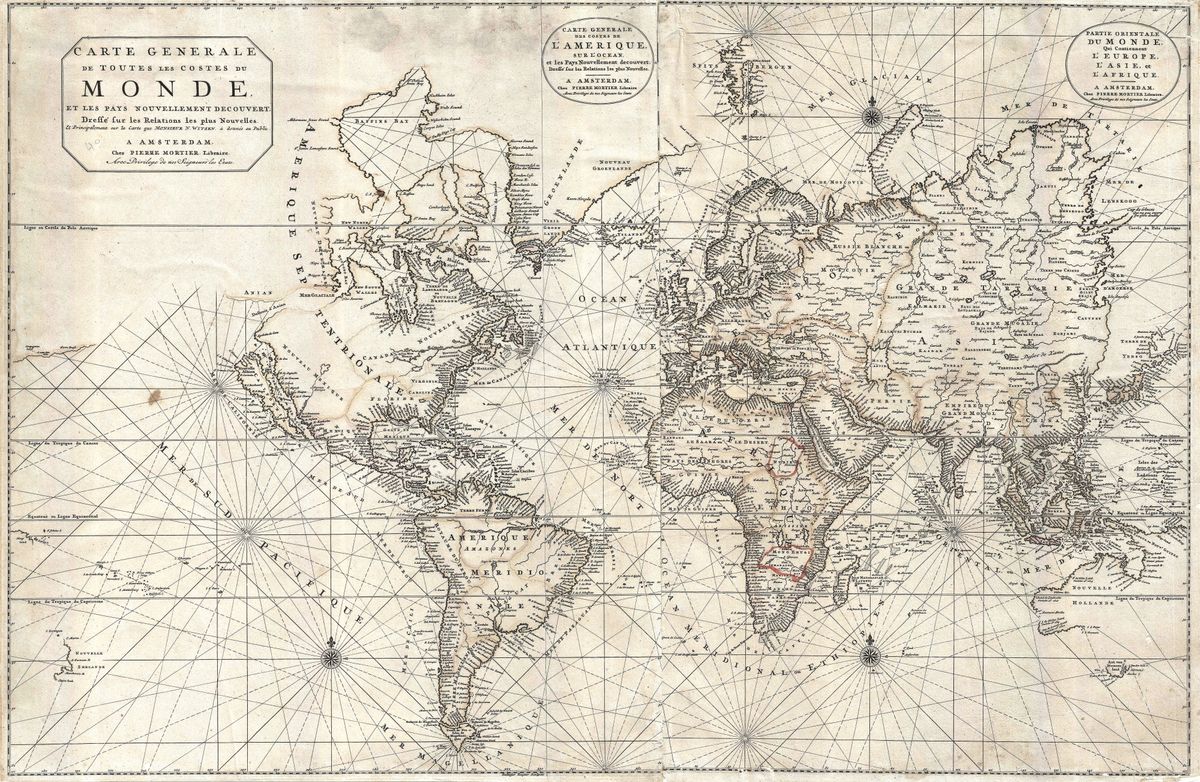
The World — Antique Map (1703)
Pieter Mortier, 1703 — World
This is not an ordinary world map but a marine chart — a Carte Générale de toutes les Costes du Monde, a general chart of all the coasts of the world. Drawn on a single projection and webbed with the radiating rhumb lines and compass roses of the navigator's craft, it presents the continents as a sailor saw them: a framework of coastlines, capes and harbours strung around the great oceans. Published in Amsterdam around 1703, it reflects the state of maritime knowledge at the height of the age of sail.
Pieter Mortier and the Amsterdam trade
Pieter Mortier (1661–1711) built his Amsterdam house on a shrewd insight: the most sumptuous charts of the age were engraved in Paris, and there was a ready market for them across northern Europe. He secured the rights to reproduce the finest French work, and the firm he founded would later become the celebrated partnership of Covens & Mortier. His sea charts combine French scientific geography with the decorative confidence of the late Dutch golden age.
A chart for the age of sail
The rhumb lines that cross the sheet were a working tool, not ornament: a navigator laid a course along them between compass roses. The coasts are drawn firmly where trade had charted them, while continental interiors are left comparatively open — the priorities of a mariner's world rather than a scholar's. It is a portrait of the planet as a network of sea routes.
Collecting and display
Restored in high resolution from a public-domain original, it is offered as an archival giclée print, framed and ready to hang — a striking and unusual world piece for anyone drawn to the sea, navigation or the golden age of Dutch cartography.
Browse all Antique World & Regional Maps →
Catalogue & provenance
- Title
- Carte Generale de Toutes les Costes du Monde
- Source
- Suite du Neptune François (Pieter Mortier, Amsterdam)
- Edition / state
- A single-projection Mercator sea-chart of the world's coasts, criss-crossed by rhumb lines from compass roses, published by Pieter Mortier after the French marine cartography he reissued for the Dutch market. (Distinct from the double-hemisphere world map Mortier engraved for his historical Bible.)
- Catalogue reference
- cf. Shirley, Mapping of the World, no. 599
- Held by
- Koninklijke Bibliotheek (National Library of the Netherlands); Harvard Map Collection.
Public-domain original; this is a restored, watermarked reproduction. We never distribute the high-resolution master. Catalogue data compiled from the institutions above.