Home › Antique World & Regional Maps › India
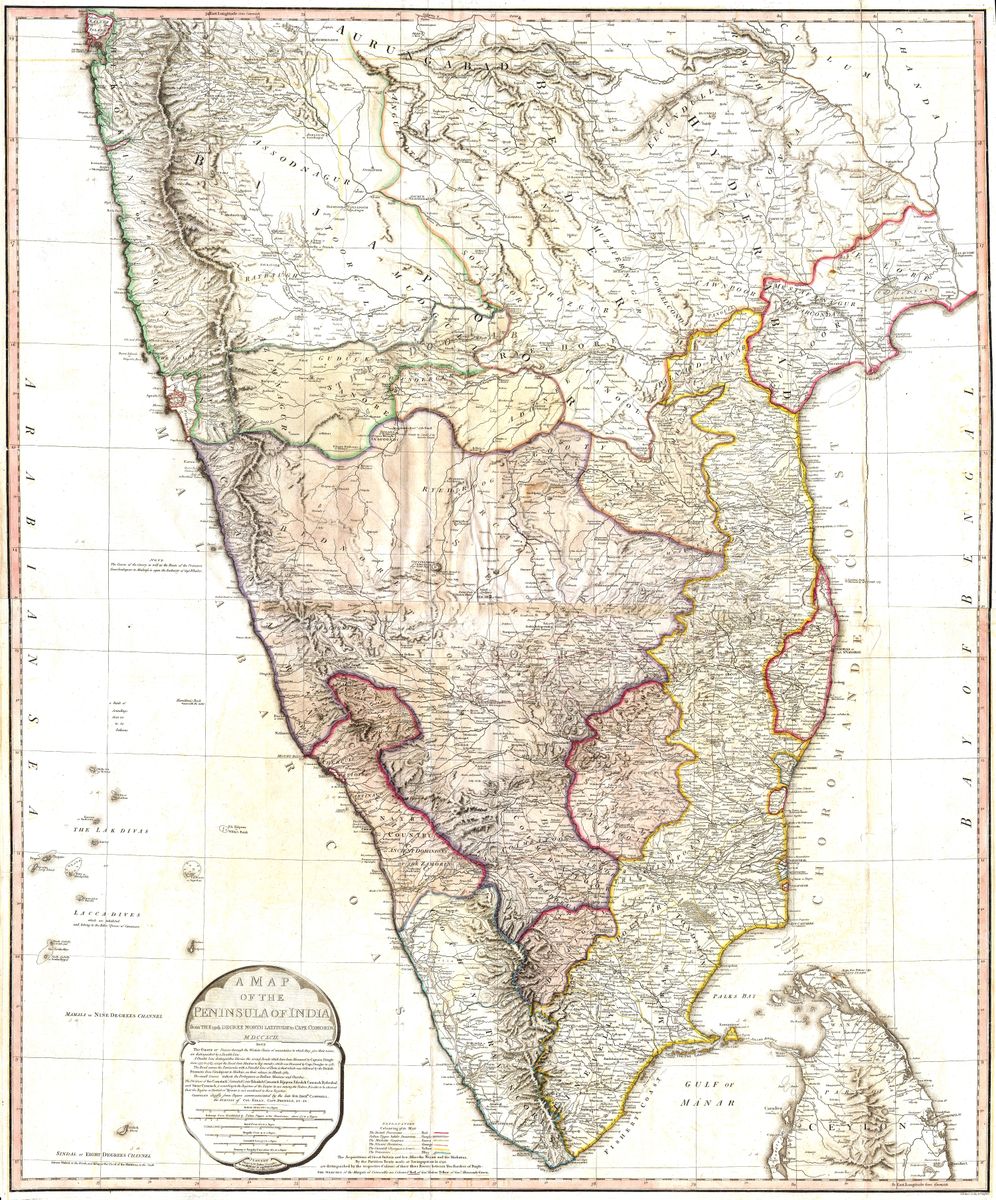
India — Antique Map (1793)
William Faden, 1793 — India
This map of the Indian peninsula, published by William Faden in 1793, presents the south of the subcontinent in the fine, dense engraving of the late Georgian period. As its title states, it runs from the nineteenth degree of north latitude down to Cape Comorin, with the island of Ceylon at its foot — tracing the Coromandel and Malabar coasts and the inland kingdoms of the Deccan and the south. By the 1790s European surveying in southern India had advanced considerably, and a map such as this reflects a markedly more accurate picture of the interior than the conjectural charts of a century before.
William Faden, geographer to the King
William Faden (1749-1836) was the foremost English mapmaker of his generation and held the appointment of geographer to King George III. Successor to the renowned house of Thomas Jefferys, Faden published maps of the highest quality on the events and regions that preoccupied Britain, from the American war to the campaigns and territories of the East. His output drew on the best available surveys and official sources, and his sheets were prized for their authority and finish. His maps of India belong to a period when accurate cartography of the subcontinent was both a scholarly achievement and an instrument of expanding British interest.
India in the age of the Company
The late eighteenth century was a transformative era for the Indian subcontinent. The Mughal empire had fragmented into successor states, regional powers contended for supremacy, and the East India Company had grown from a trading concern into a territorial force, particularly in Bengal and along the eastern coast. Mapping the land was bound up with governing and exploiting it, and the great surveys of the period produced geography of new precision. A map of India from 1793 therefore stands at the threshold of the colonial century, recording a subcontinent of many states on the verge of profound change.
The map as a political document
This is no neutral survey. Political control is laid out in colour: the territories administered by the British East India Company are washed in one tint, set against the lands of the Kingdom of Mysore — ruled in these years by Haider Ali and his son Tipu Sultan, the most determined opponents of British expansion in the south. Compiled from the surveys of Major James Rennell, the map records the subcontinent at the very moment the Company was turning from a trading concern into a territorial power.
Collecting and display
Restored in high resolution from a public-domain original, this print preserves the intricacy of the engraving and the warm patina of the antique paper while presenting it clearly. It is produced as an archival giclée print and supplied framed, ready to hang. Richly detailed and historically resonant, it makes a rewarding piece for anyone with a connection to India or an interest in the age of empire.
Browse all Antique World & Regional Maps →
Catalogue & provenance
- Title
- A Map of the Peninsula of India from the 19th Degree North Latitude to Cape Comorin
- Source
- Published by William Faden (London)
- Edition / state
- First edition, dated 1 May 1793; compiled by Louis Stanislas d'Arcy de la Rochette after James Rennell and the British East India Company, engraved by William Palmer. Issued in two sheets (northern half; southern half with Ceylon). (Distinct from Faden's separate 'Hind, Hindoostan, or India' plate.)
- Dimensions
- Single sheet plate 49 × 80 cm (19.3 × 31.5 in); joined, plate 98 × 80 cm (38.6 × 31.5 in)
- Catalogue reference
- David Rumsey 14383.045 / .046 / .047
- Held by
- David Rumsey Map Collection; British Library, Map Library.
- View the original
- David Rumsey Map Collection ↗
Public-domain original; this is a restored, watermarked reproduction. We never distribute the high-resolution master. Catalogue data compiled from the institutions above.
Featured in the Journal
A map coloured for empire: the Company against Tipu Sultan →
Faden's 1793 map of the Indian peninsula shades political control — and marks Britain's fiercest opponent.